
Why Corporate Wellness Programmes for Stress Keep Failing
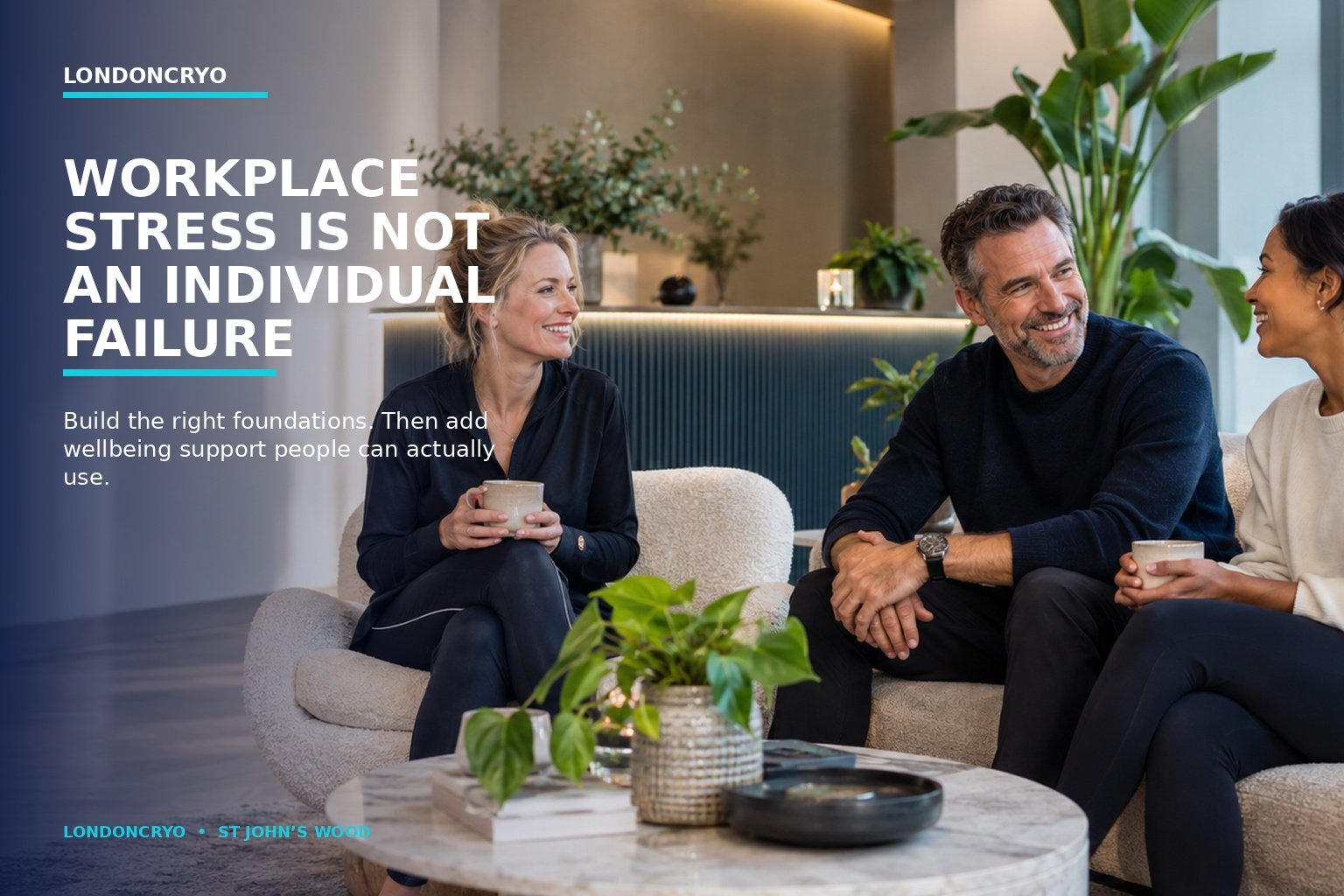
Corporate wellbeing in London
Why Corporate Wellness Programmes for Stress Keep Failing
If your people are exhausted, another app, lunchtime webinar or occasional perk will not repair an overloaded role, an unclear manager relationship or a culture of constant availability. A credible wellbeing strategy begins with how work is designed. Only then should employers ask how additional experiences may help people pause, recover and feel supported.

The problem is bigger than the perk
Work-related stress is not a marginal workplace issue. The Health and Safety Executive reported that 964,000 workers in Great Britain were suffering from work-related stress, depression or anxiety in 2024/25. Those conditions accounted for 22.1 million working days lost.
Yet many wellbeing programmes still ask the individual employee to become more resilient without changing the conditions creating the pressure. When workloads remain unrealistic, priorities change without warning and people feel unable to speak up, a meditation app may become one more task on an already impossible list.
A 2024 Oxford study of more than 46,000 UK workers found no evidence of improved wellbeing from most individual-level interventions it examined, including mindfulness, resilience and stress-management activities, relaxation classes and wellbeing apps. The study was observational, so it should not be treated as proof that every programme fails. It does, however, reinforce an important point: individual benefits cannot replace better organisational practice.
What UK employers need to address first
UK employers have a legal duty to protect workers from stress at work by carrying out a risk assessment and acting on it. The HSE Management Standards identify six areas of work design that can contribute to stress when they are not managed properly:
- Demands: workload, working patterns and the work environment.
- Control: how much say people have in the way they do their work.
- Support: resources, encouragement and help from the organisation, managers and colleagues.
- Relationships: positive working, conflict management and unacceptable behaviour.
- Role: whether people understand their responsibilities and conflicting roles are avoided.
- Change: how organisational change is managed and communicated.
This is where a serious strategy starts. Look at the data, consult employees and act on the findings. A wellbeing day cannot compensate for a role that is structurally unsustainable.
Why employees often do not use the support on offer
Low participation is not always a sign that people do not care about wellbeing. The offer may be badly timed, difficult to book, disconnected from their needs or quietly stigmatised by managers. A lunchtime session also sends a revealing message: wellbeing is available, but only if the employee gives up their break.
Ask practical questions. Can people participate during paid working time? Is the offer genuinely voluntary? Does it work for hybrid and remote employees? Are managers visibly supportive? Can employees choose an experience relevant to how they feel rather than being placed into a generic programme?
Where LondonCryo may fit
Once the organisation is addressing the causes of work-related stress, LondonCryo can help create an optional, premium wellbeing experience for employees.
Rather than selling one treatment as the answer, we begin with the outcome the organisation and its people want: protected recovery time, an energising team experience, support around a demanding period or access to a broader wellbeing routine.
A tailored experience may draw on LondonCryo’s four pillars—cold, heat, oxygen and nutrition—alongside services such as compression, red light and lymphatic support, where suitable. The format may include an in-clinic team experience, individual employee visits or a carefully designed benefit pathway.
These are wellness services. They are not treatments for burnout, work-related stress, depression, anxiety or any other medical condition, and they do not remove the employer’s duty to assess and manage workplace risks.
Measure usefulness—not private health
Employers can monitor participation, accessibility, employee feedback, sickness absence trends, staff turnover and whether actions arising from the stress risk assessment were completed. Avoid turning a wellbeing programme into a surveillance exercise.
Health information is special-category data under UK GDPR. If an employer collects it, the organisation needs an Article 6 lawful basis and an Article 9 condition, alongside clear purpose, data minimisation and appropriate protection. Individual treatment or health information should not be shared with line managers as routine programme reporting.
Five questions before buying another wellbeing benefit
- What did our stress risk assessment identify?
- Which workplace causes are we changing?
- Can employees use this offer easily and during appropriate time?
- Is it voluntary, inclusive and relevant to different needs?
- How will we measure participation and usefulness without collecting unnecessary health data?
Frequently asked questions
Can a corporate wellness programme prevent burnout?
No programme should promise to prevent or treat burnout. Employers should first assess and manage work-related stress. Optional wellbeing support may complement that work, but it cannot replace it.
What are the HSE’s six Management Standards areas?
They are demands, control, support, relationships, role and change. They help employers assess the organisational factors that can contribute to work-related stress.
Can LondonCryo design a team wellbeing experience?
Yes. LondonCryo can discuss a tailored, voluntary experience for London-based teams using suitable services from its cold, heat, oxygen and nutrition pillars. The format depends on team size, goals, suitability and availability.
Does LondonCryo treat workplace stress or burnout?
No. LondonCryo’s corporate offer consists of wellness experiences. It is not a medical or occupational-health service and does not replace medical advice, mental-health support or an employer’s health-and-safety responsibilities.
Where is LondonCryo?
LondonCryo is at 82 St John’s Wood High Street, London NW8 7SH.
Build a wellbeing offer your people can actually use
Tell us about your team, the outcome you want and the practical constraints. We will discuss whether a tailored LondonCryo experience is appropriate.
REQUEST A CORPORATE WELLBEING CONVERSATION
Looking for individual support? Begin with the £99 Personalised First Visit
Important: LondonCryo provides wellness services, not occupational-health, mental-health or medical treatment for workplace stress or burnout. All services are subject to individual suitability and availability. Employers remain responsible for assessing and managing work-related stress.
